
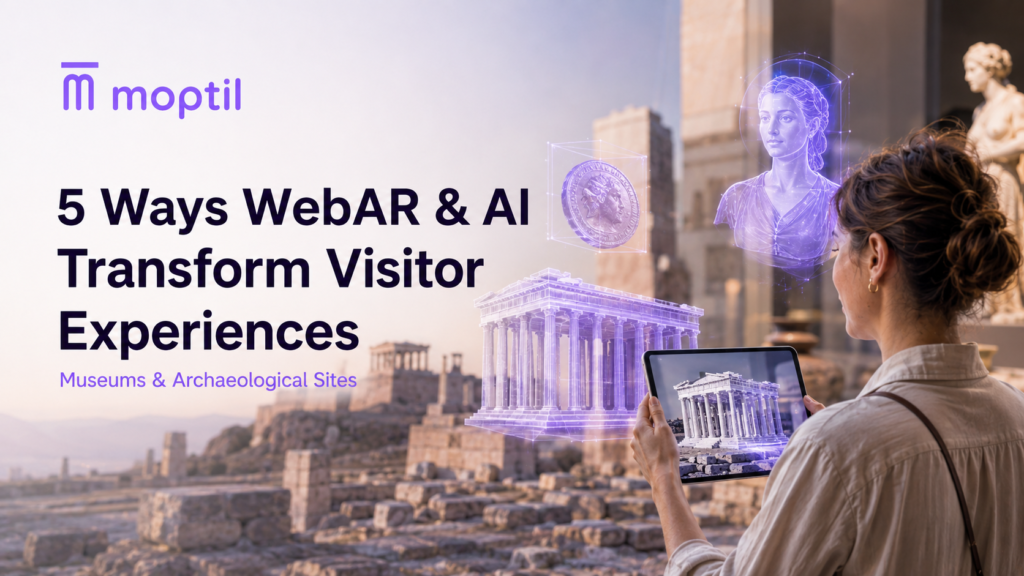
Digital technology is changing the way people discover and interact with cultural heritage.
Visitors increasingly expect experiences that go beyond traditional signs, printed guides and static displays. Technologies such as WebAR, 3D content and Artificial Intelligence can help cultural organisations create new layers of interpretation while keeping the physical monument, exhibition or destination at the centre of the experience.
The MOPTIL WebAR & AI Cultural Experience Platform brings these technologies together in a unified web-based environment, helping organisations manage digital assets, create WebAR scenes and connect interactive digital characters with structured knowledge.
Here are five ways these technologies can enhance the visitor experience.
1. Bring Historical Reconstructions to Life with WebAR
One of the most powerful applications of Augmented Reality in cultural heritage is the ability to connect the present-day site with its historical appearance.
At an archaeological site, visitors can use a WebAR experience to explore 3D reconstructions of monuments and historical structures within the context of the physical environment.
Instead of simply imagining how a monument may once have appeared, visitors can interact with a digital reconstruction and gain a better understanding of its original scale, architecture and historical context.
Because the experience can be delivered through web technologies, WebAR can also provide a flexible way to introduce interactive digital content as part of the visitor journey.
Example use case
A visitor standing near the remains of an ancient structure could access a digital experience presenting a reconstructed 3D version of the monument together with contextual information about its history.
2. Turn Museum Exhibits into Interactive Digital Experiences
Museums already hold valuable collections, stories and research. Digital technologies can add a new interpretative layer around these assets.
Using 3D content and WebAR, an object displayed inside a museum can become the starting point for a richer digital experience.
Visitors could explore a three-dimensional reconstruction, examine additional visual material or access contextual information that would be difficult to present within the physical exhibition itself.
This approach can help museums enrich exhibitions without replacing the original object.
The goal is not to move attention away from the collection, but to provide visitors with additional ways to understand and explore it.
Example use case
A museum exhibit could be accompanied by a digital 3D representation that visitors can rotate and examine while accessing related historical information and interactive content.
3. Introduce AI-Powered Digital Cultural Guides
Artificial Intelligence can also create new ways for visitors to interact with cultural information.
Instead of following only a predefined sequence of information, an AI-powered digital character or Avatar can be connected to organised cultural knowledge and structured question-and-answer content.
Visitors can therefore interact with the digital guide and explore information according to their own interests.
For museums and cultural sites, this creates opportunities for more conversational and personalised forms of digital interpretation.
An AI Avatar could represent a historical personality, a fictional guide or a digital museum assistant depending on the needs of the experience.
From information to interaction
Traditional digital guides primarily deliver information.
AI-powered experiences can add another layer: interaction.
The visitor becomes an active participant who can explore different topics rather than simply following a fixed presentation.
MOPTIL’s platform includes an Avatar Knowledge workflow, allowing digital characters to be connected with organised knowledge and Q&A content.
4. Create Multilingual Experiences for International Visitors
Cultural sites and museums often welcome visitors from many different countries.
Providing meaningful information in multiple languages can therefore be an important part of the visitor experience.
Digital experiences make it possible to organise cultural information so that visitors can access content in different languages depending on the requirements of each project.
A single interactive experience can therefore be designed for a broader international audience while maintaining a consistent visual and technological environment.
Why multilingual experiences matter
For an archaeological site, museum or tourism destination, multilingual digital content can help:
- improve accessibility of cultural information,
- serve international audiences,
- support different visitor profiles,
- and create a more inclusive experience.
This becomes particularly relevant for destinations with significant international tourism.
5. Reuse Digital Assets Across Multiple Visitor Experiences
Creating high-quality cultural digital content requires investment.
3D models, images, historical information and other digital assets can therefore become particularly valuable when they can be organised and reused across different experiences.
Instead of treating every new digital experience as an isolated project, cultural organisations can create a structured collection of reusable content.
The MOPTIL platform includes a File Manager for organising 3D models, images and other assets, a WebAR Scene workflow for assembling and previewing experiences, and an Avatar Knowledge environment for managing structured content associated with digital characters.
This type of workflow can support the creation of multiple experiences from a common digital content base.
For example, the same 3D reconstruction could potentially support:
- an onsite archaeological experience,
- a museum presentation,
- an educational activity,
- or a digital tourism experience.
The commercial positioning of the platform is specifically based on content reuse, standardised production of new experiences and the ability to preview and export experiences for demonstration or deployment.
From Digital Content to Meaningful Visitor Experiences
WebAR and Artificial Intelligence are not simply technologies to add to a cultural site.
Their real value comes from how they are used to connect people, stories, places and cultural content.
For museums, archaeological sites and tourism organisations, the opportunity is to create experiences that help visitors:
see more, understand more and interact more deeply with cultural heritage.
The MOPTIL WebAR & AI Cultural Experience Platform has been designed to support this process by bringing together 3D assets, WebAR experiences and AI-powered digital characters within a unified web environment. This positioning is also reflected in MOPTIL’s product identity, whose core message is the transformation of cultural 3D content into organised WebAR experiences and interactive AI characters.
Interested in Exploring What This Could Look Like for Your Organisation?
Whether you manage a museum, archaeological site, cultural organisation or tourism destination, MOPTIL can help you explore how WebAR, 3D content and AI could be applied to your visitor experience.
Request a demonstration of the MOPTIL WebAR & AI Cultural Experience Platform and discuss a potential use case for your organisation.
This project is carried out within the framework of the National Recovery and Resilience Plan Greece 2.0, funded by the European Union – NextGenerationEU

