
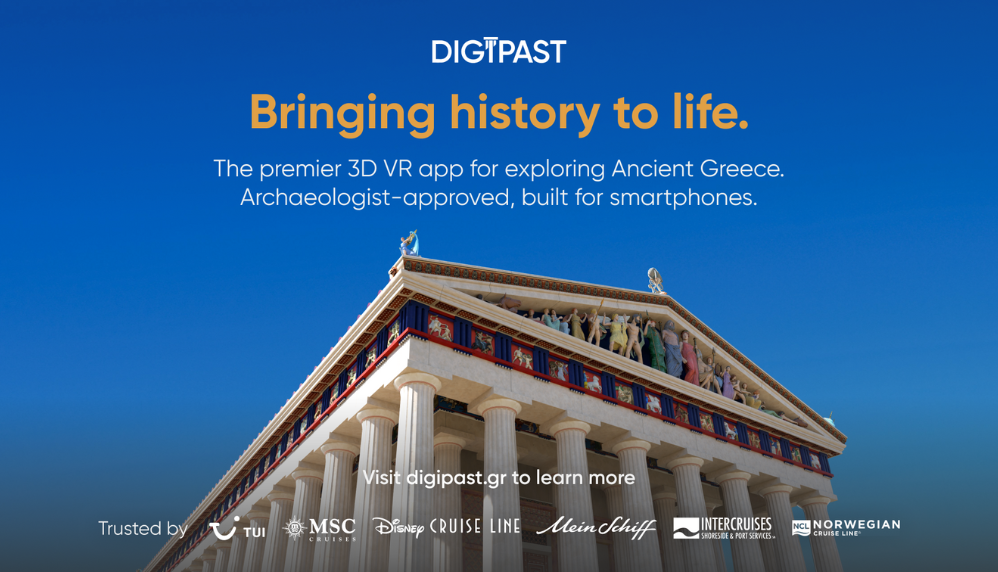
DIGIPAST is the flagship product of the Greek company MOPTIL – Mobile Optical Illusions, which has been pioneering XR experiences in cultural tourism since 2013. It is one of the first initiatives in Europe to leverage Virtual Reality technologies to revive archaeological sites, at a time when such applications were still largely unknown.
With a history spanning more than ten years, DIGIPAST was the first to introduce digital reconstructions of the past to the Greek tourism market, replacing outdated practices such as printed illustrations. Until 2024, the application was offered through tablet rentals to tour operators, serving more than 600,000 visitors.
Despite the objective challenges associated with visiting archaeological sites, especially during the summer months, DIGIPAST succeeds in delivering premium, high value-added experiences, meeting the heightened expectations of modern audiences and consistently receiving very positive feedback.
Its development is based on close collaboration with distinguished academics and archaeologists, ensuring historical accuracy and scientific validity. Temples, monuments, and entire cities are faithfully recreated in terms of style, structure, and environment, transforming the experience into an open, digital archaeological excavation.
From mobile app to progressive web app
The original version of DIGIPAST relied on native mobile applications and dedicated equipment (tablets). However, everyday use highlighted significant barriers for both tourism professionals and end users: device maintenance costs, the need to install applications, and limitations arising from different operating systems.
As a result, after 12 years of continuous presence and a leading position in the market, DIGIPAST proceeded with a strategic technological upgrade: the transition to a progressive web app and a bring-your-own-device usage model. This decision was based on real market needs and was accompanied by substantial investment in human resources and infrastructure.
The new approach radically transformed accessibility. Visitors gain instant access to the experience simply by scanning a QR code, with no installation, login, or technical support required. The “scan and go” model led to an increase in conversions of over 50%, while significantly expanding usage among visitors with lower levels of digital familiarity.
At the same time, DIGIPAST supports offline functionality and is offered as a bundled service with WiFi hotspots, ensuring a seamless experience even in locations with limited connectivity.
New design and functionality
The new web app follows a mobile-first architecture, with a strong emphasis on usability: clean typography, one-handed navigation, instant language selection, and exceptionally fast loading times (around 3 seconds). The application is available in 9 languages, while AI-powered automatic translation is in the final stage of pilot testing.
The new structure allows DIGIPAST to be easily integrated into B2B partnerships, enabling tour operators to offer the experience directly within their programs and guided tours, without the need for additional infrastructure.
Market trust and measurable results
DIGIPAST is already in use at 8 of the 11 active archaeological sites, with each experience activated via a unique QR code that leads to curated 360° VR content. The three-dimensional models are created by specialized 3D artists in collaboration with archaeologists, accurately depicting monuments as they appeared in antiquity.
Major international players, such as TUI, have already incorporated DIGIPAST into their offerings. At the same time, the transition to the web app resulted in a 107% increase in license activations (February to April 2025) and a 191% increase in licenses to travel agencies, confirming strong market acceptance of the new model.
Strategic vision
The journey of DIGIPAST reflects a clear vision: technology should serve as a tool to highlight and interpret culture, not as an end in itself. The choice of a web-first model demonstrates a mature approach to innovation, grounded in simplicity, sustainability, and respect for the visitor.
